 Culture Tree
Focused on shared results
Generative
Room to grow, and care that supports it.
Cultural transformation for digital businesses
You can’t order a culture to change.
You can change what it grows from.
Seven connected layers, from how requests arrive to how people respond to problems. Open any layer on the plate, or let the key suggest where to start.
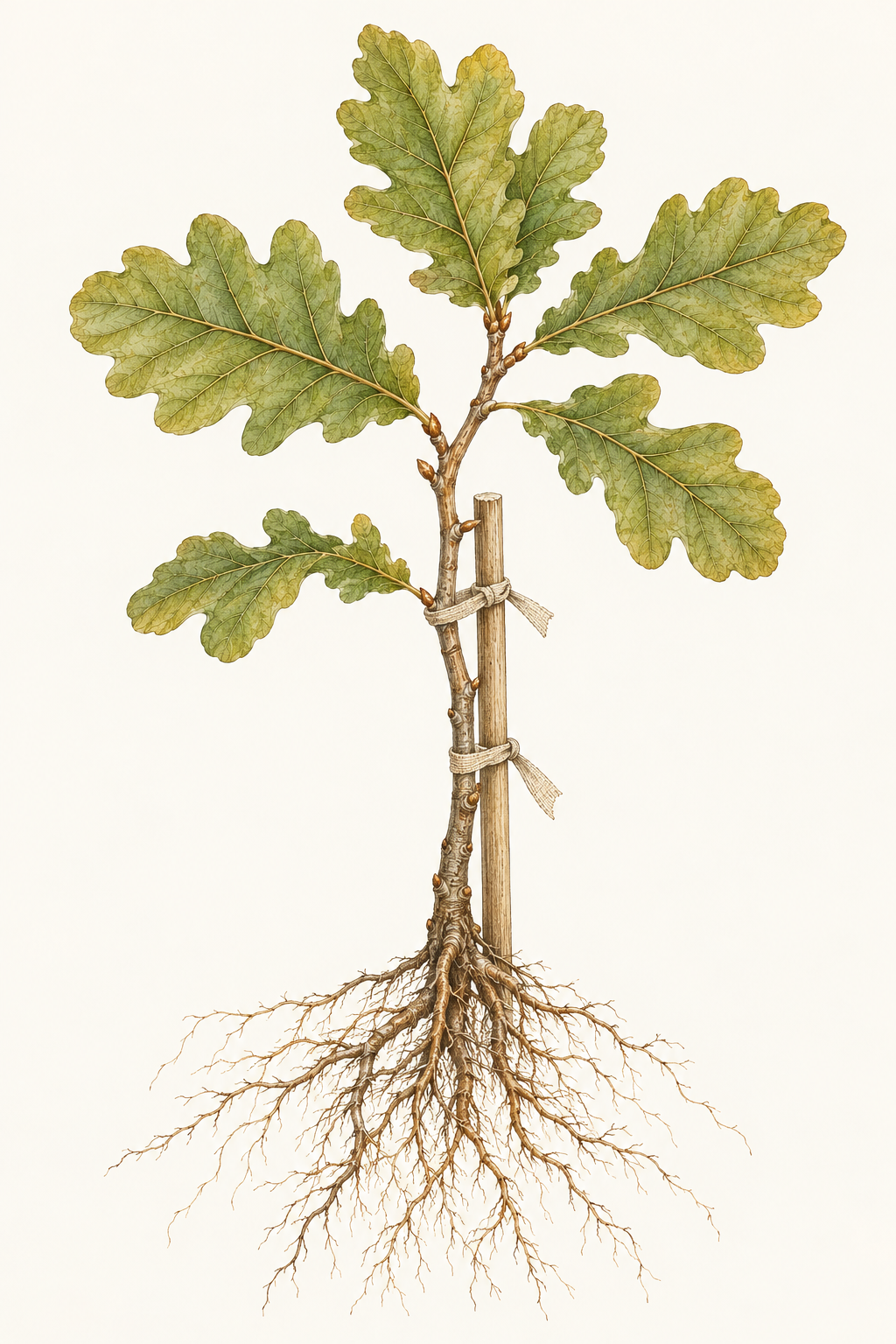
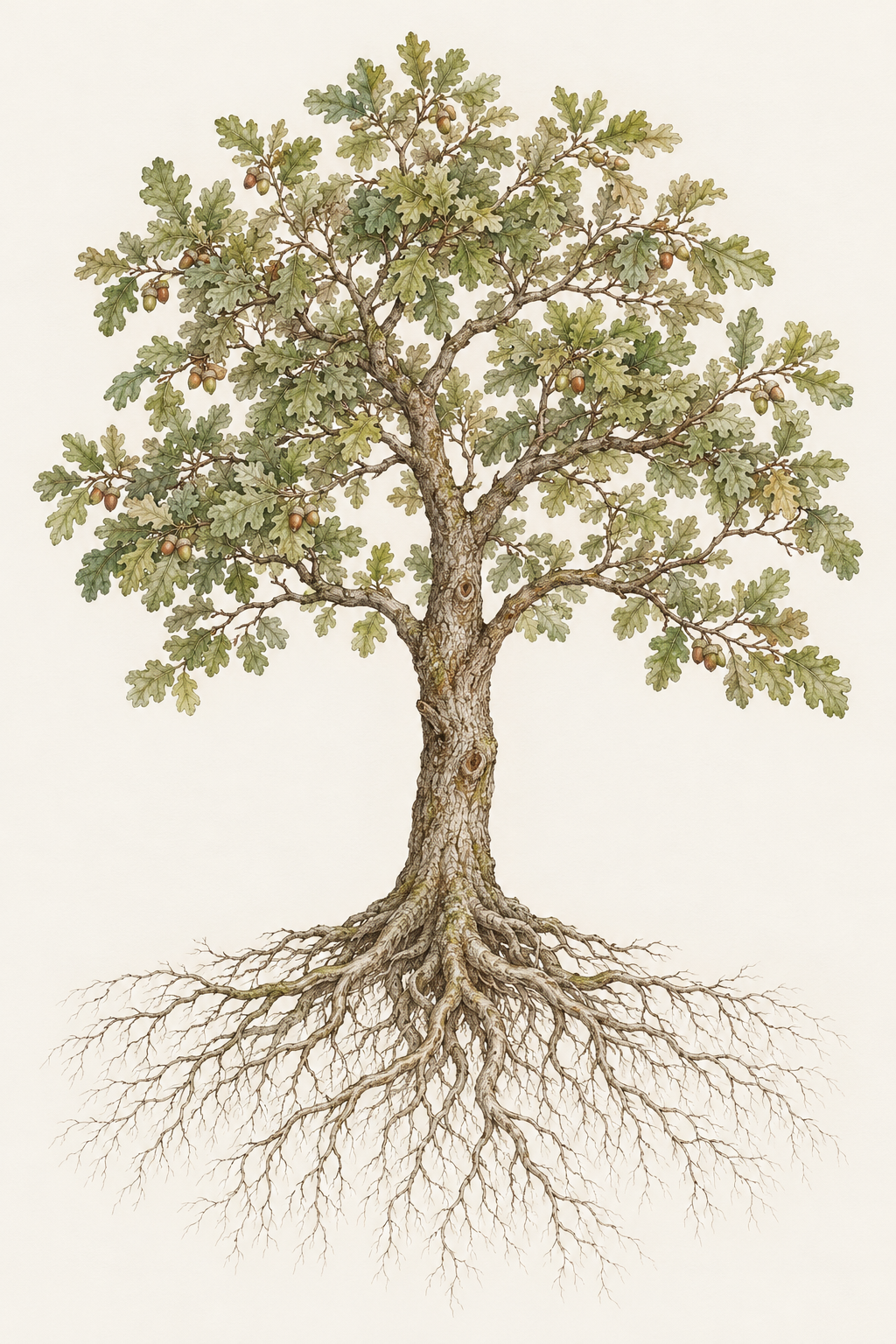 CanopyCultureBoughsValuesBranchesPracticesTrunkTeamsRootsArchitectureFine rootsEngineeringSoilRequests
The principle
Culture is the shared pattern of how people act, decide, and respond to problems. It grows from what everyday work makes possible, rewards, or discourages.
The seven layers connect management choices with technical choices. Use them to find a practical starting point, then check whether the change supports the behavior you want. The layers influence each other; they are not a fixed sequence of steps.
Waiting can look like a lack of initiative, even when the approval process makes it the sensible choice.
Start with a behavior you want to change. Find the circumstances that sustain it. Change one, observe what happens, and adjust.
Suppose a team needs permission for every small release. Automated checks and a reliable way to undo a release can make routine changes easier to trust. Leadership can then give the team clearer authority to act within agreed limits.
The team releases a change, sees its effect, and takes responsibility for the next step and stays accountable for its effects. Repeated experience can make ownership a shared habit. The technical work and the management decision support each other.
Could it help me? · A key to your situation
Culture Tree applies wherever people and software change together. Your situation decides where to begin, not whether it applies. Answer three questions; the tree shows which layers to open first.
You don’t need a title to start. Change needs someone willing to begin and someone with authority who supports it, or at least doesn’t block it. Ideas travel between people; a reader today can be the ally of whoever starts tomorrow.
Culture · Canopy
When someone brings bad news, do people learn from it, protect a procedure, or protect their position? Ron Westrum’s three culture types help name these patterns. Different teams in the same company may show different patterns.
Plate II · Three patterns of growth
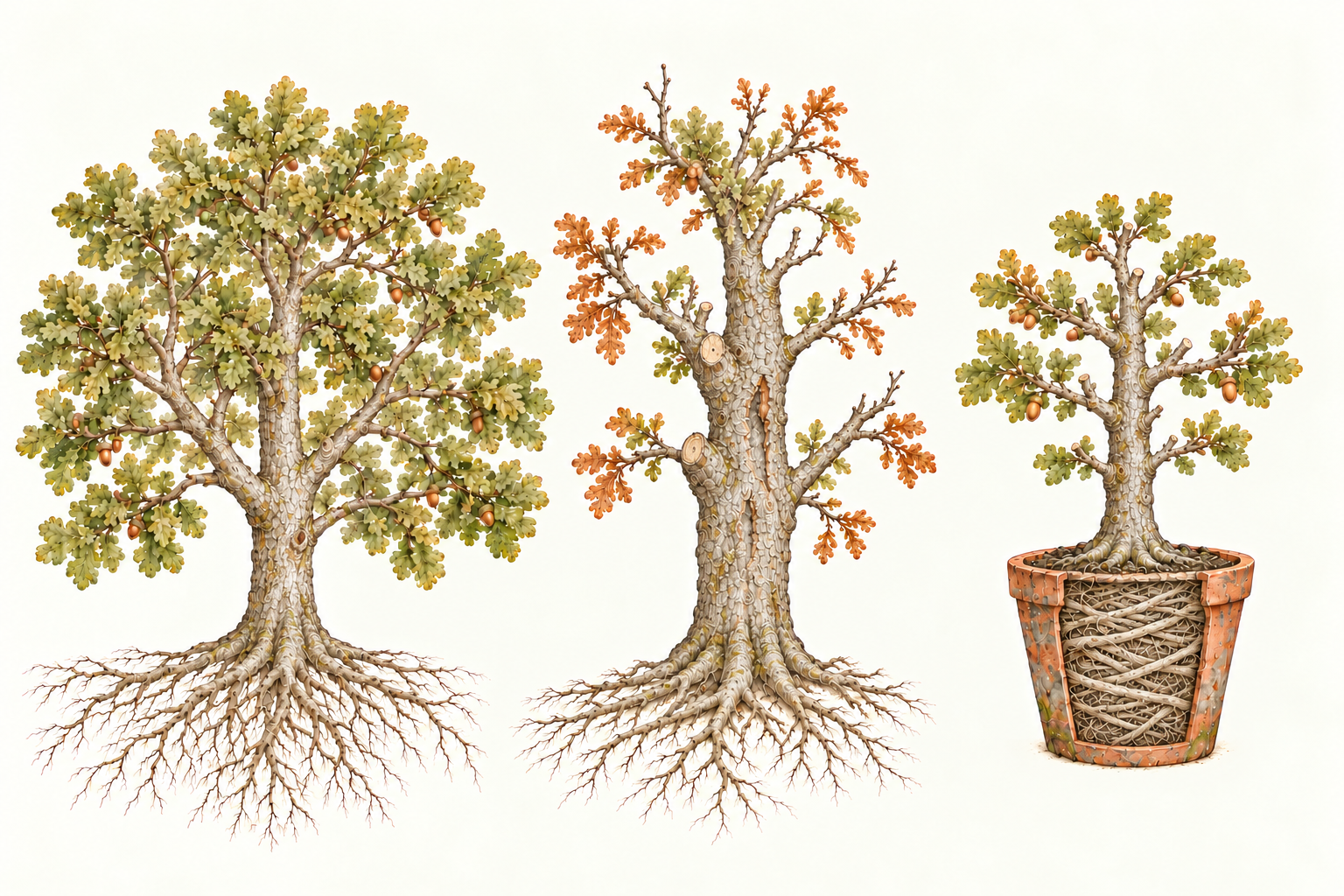
Focused on shared results
Room to grow, and care that supports it.
Focused on power
Growth pursued at the expense of long-term health.
Focused on rules
Growth permitted only within the prescribed shape.
Choose an aspect to change the three descriptions below.
Performance and mission
Power and control
Rules and processes
Circumstances can support growth, force it at lasting cost, or hold it within prescribed limits. What circumstances shape behavior in your organization?
Choose the description closest to your team. These eleven prompts extend the culture typology for discussion; they are not Westrum’s validated survey. Compare your answers with someone in another role.
Values · Boughs
A digital business brings people and software together to help customers accomplish something—for example, complete a repayment without needing to call support. That practical improvement is a customer outcome. Values become credible when decisions, responsibilities, and tools support such improvements.
Teams can try small changes, see the results quickly, and change course when they learn something new.
People solving the same problem can talk directly and see each other’s work in progress.
The team has a clear purpose, authority to make decisions, and access to the skills and tools it needs. It is responsible for the work and accountable for the results.
Practices · Branches
Try a small change, look at the result together, and decide what to do next. Direct communication keeps the evidence close to the people who can act on it.
A small experiment
Try an interface improvement with a limited group of users. Decide in advance what you expect to improve and what would make you stop.
What is the smallest useful change we can test?
Teams · Trunk
Ownership combines responsibility for doing the work with accountability for its effects: checking results, explaining decisions, and following through when something needs to change. The team needs the authority and skills to carry both from the first report through to the result.
The people involved can investigate and act together. The team remains responsible for the work and accountable for its results.
Each hand-off can add waiting or lose context. Where work crosses team boundaries, make responsibility and accountability explicit.
Stream-aligned teams follow a customer need through to its outcome.
Platform teams provide shared tools and services.
Enabling teams help other teams develop skills and remove obstacles.
The team can address the immediate problem, investigate the cause, and check whether the change helped. When another team is needed, agree how they will work together, who is responsible for each part, and who remains accountable for the result.
Architecture · Roots
A team needs more than permission to act. If every change depends on software owned elsewhere, it still has to wait. Align team responsibilities and software boundaries where this helps work move.
Follow a change to lending through the highlighted column. Compare how many teams need to coordinate.
| Technical layer | Lending | Collections | Assets | Product |
|---|
Keep things that usually change together close together.
Give each part a clear job and a clear way to interact with other parts.
Reduce the number of other parts that must change at the same time.
Use the same words for the same business concepts in conversations, requirements, and code. Domain-driven design calls this a shared, or ubiquitous, language.
Engineering · Fine roots
These are three different questions. Code can pass its tests while a customer still struggles. A feature can work as designed while solving the wrong problem.

Test-driven development (TDD) uses a test to describe the behavior you need. Make the test pass, then improve the code’s structure while keeping that behavior intact.
Write a failing test → Make it pass → Improve the design
Define acceptance criteria and make feedback fast.
Address security during design, with specialist advice and checks built into delivery.
Share unfinished work and unknowns early, while changing direction is still affordable.
SPACE
DORA delivery measures
Read these measures together and follow the same service over time. Pair them with customer outcomes and team experience. DORA’s current definitions explain these five measures.
Requests · Soil
A feature request or a bug report is a clue to a problem. Find out who is affected and what they need to accomplish. Then choose a small response that can help them and teach the team something.
Assembled from parts Nothing works until the last part is in place.
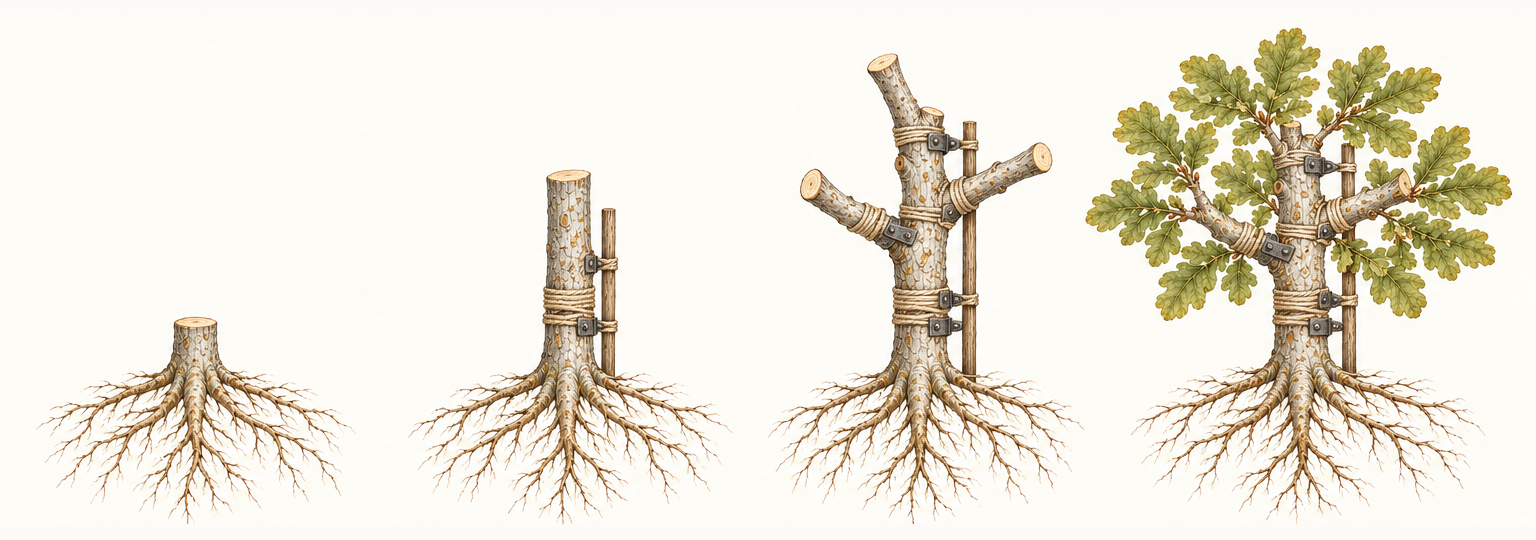
Plan it all
Build the base
Add the features
Release, at last
Grown from a seed Small, but whole and alive at every stage.
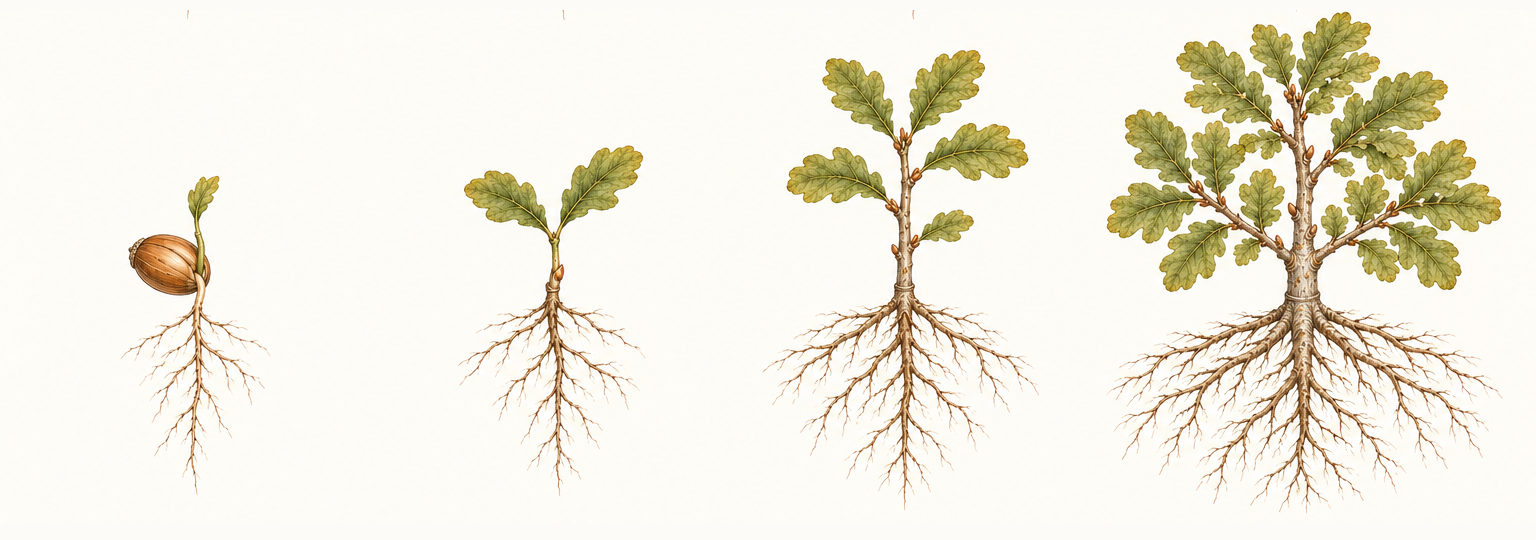
A real need
A useful first step
Observe and adjust
Expand what works
Sort what arrives
A need the product does not meet yet
Something that should already work
John Seddon calls these value demand and failure demand. Bug reports, status chasing, and repeated complaints are failure demand: work the organization creates for itself. Count both, and treat a high share of failure demand as a signal from the layers above.
Follow failure demand up the tree
Decide how much to invest
Design Time required
Time available A fitting design
“Appetite” means the time you are willing to invest. Shape a useful response within that limit, and explore the least understood part before committing to the rest.
Keep the work lean
How can I apply it?
Start with one team and one real problem. The pathway below sets up the experiment; the instruments help the team look at each layer together. Use them in the order your situation needs. The key suggests where to begin.

From the model to a first experiment
Choose one team and a concrete problem. Agree what it can change, what support it needs, and how you will judge the result. Choose a duration that fits the question you need to answer, with regular opportunities to review progress.
Name the behavior you want to change and the circumstances behind it. Record the current customer, delivery, and team experience.
Agree the team’s authority, support, and limits. Discuss what could disrupt the experiment before committing.
Make the agreed changes to responsibilities, tools, and practices. Help the team learn from small deliveries and regular feedback.
Compare results with the starting point. Keep, revise, or stop the changes. Help another team adapt what worked to its own situation.
The instruments
Each instrument opens a conversation about one layer: what you see now, and what one changed circumstance would do.
Field notes / The AI era
An AI agent is software you design and a contributor you guide, so both halves of the tree apply to it at once. Who chooses the next action? What does it know? How will the result be checked? The questions are the same; agents make the answers explicit.
Plate V · People & software
The same principles take different forms in human collaboration and software design. Read across the waterline to see how one reflects the other.

Seven layers, read for agents
The method took shape before agents joined everyday work. Read layer by layer, it already describes how to work with them.
Look at how people respond to problems.
Let bad news travel fast, from agents too.An agent that cannot say “I’m stuck” will produce something that only looks finished. Ask for uncertainty and blockers. Treat an agent’s failure as information about its circumstances, not a reason to blame or ban the tool.
Make the values visible in the work.
Values reach an agent only in writing.What people learn by example, an agent does not. Put the values where it works: instructions, examples, acceptance criteria, and review checks.
Make learning part of the daily work.
The agent forgets; the circumstances remember.A lesson from one session is gone in the next unless it changes an instruction, a tool, or a check.
Keep responsibility and accountability together.
An agent can take responsibility, not accountability.Name the person who answers for each agent’s work. Keep hand-offs between agents few: like hand-offs between departments, each one loses context.
Let teams change the software they own.
Context is contextual.Modularity gives a team autonomy; it gives an agent a context it can hold. Keep each iteration inside one bounded context, with its own language and interfaces. Crossing a border starts a new iteration.
Check the code, the experience, and the outcome.
Tests carry intent.Write acceptance criteria before an agent implements: they guide the work and check the result. More code is not more value, so review the outcome, not the volume.
Start with a real need and a useful first change.
Judgment becomes the scarce part.An agent will build the ready-made solution it is given. Find the need first, hear the owner before the agent’s analysis, and set an appetite for agent work too.
Learning from work with AI
I’m developing Falconer, a tool that uses AI to review how easily people can use a website. Designing its workflow has brought two practices into focus.
These practices are still being developed; their effect on organizational culture remains to be tested. Read the practices and their connection to Culture Tree.
These are questions for further work, not demonstrated outcomes of Culture Tree.
Where do the conclusions come from?
The method draws on lived experience, published research, and current practice with AI agents. Each is labelled so you can weigh it for yourself.
A multi-country lending company where the same conflicts kept returning. The method grew from trying to change them, and from seeing agreement fail to change anything.
Read the account ↓ IIResearchWestrum’s culture types, the DORA research, Team Topologies, SPACE, domain-driven design, and Shape Up. Influences on the synthesis, not proof that it works.
See the sources ↓ IIICurrent practiceA product developed through an agent workflow governed by the same principles. Its practices are still being developed and tested.
Read the field notes ↗Where the method came from
The method grew out of years spent between IT and “the business,” watching the same conflicts reappear despite good intentions.
The proposal found support. A year and a half later, almost nothing had changed. That experience is part of the method: agreement alone does not change the circumstances people work in.
For seven years I worked at a lending company. IT sat in one country; finance, operations and everyone else were spread across others. The distance shaped the relationship: it worked like contractor and client, not like one company building its own product. IT people were treated as executors, and a layer of mediators translated between the two sides: product owners, project managers, IT managers. I was one of them.
About five years in, I began to see how the structure of communication kept producing the same conflicts. IT called everyone else “the business” and blamed it. The business blamed IT. Every new rule arrived as a way to protect the executor from the requester.
Reading Ron Westrum, I found a vocabulary for what I had experienced: early collaboration, later power struggles, and rules introduced as protection. I started with the work I could influence: making software ready to release in small steps, discussing expected behavior before coding, integrating changes frequently, and programming together. These practices helped people share knowledge and responsibility. They also led me to wider questions. How did the software constrain the teams? How did the teams’ responsibilities shape communication? What behavior did those circumstances encourage?
So I went from development practices to architecture, from architecture to team structure, and from there to values. The result was this method. I presented it to department heads, team leads and executives. Most of them supported it. The CEO even asked HR to turn the culture bingo into a company-wide survey. The survey never happened.
A year and a half later, almost nothing had changed.
Sources & influences
These works influenced the synthesis. Culture Tree itself is a set of hypotheses to test, not a validated intervention.
About the author
I’ve spent 10+ years in fintech and software, based in Riga, Latvia. I started in QA, went on to lead QA teams, and then worked as a software architect on a multi-country lending platform.
Now I’m building Falconer, a SaaS product developed by AI agents through a workflow I designed, and advising early-stage products as a consultant.
Put the method into practice
I can help connect the culture you want with changes in team responsibilities, software design, and daily practice—as a consultant or an in-house transformation lead.
Start a conversation